
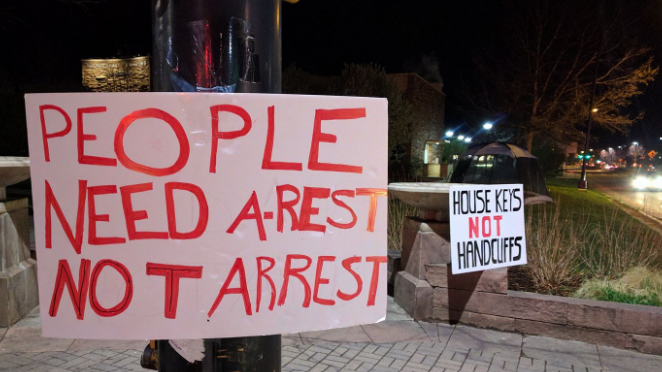
In June 2024, the Supreme Court of the United States handed down its pivotal ruling in City of Grants Pass v. Johnson. In that case, a class of involuntary unhoused individuals challenged the constitutionality of ordinances in the city of Grants Pass, Oregon, that prohibited sleeping or camping on public property and imposed criminal sanctions for repeated violations. Before reaching the Supreme Court, the United States District Court for the District of Oregon ruled that Grants Pass’ ordinances violated the Cruel and Unusual Punishments Clause and the Excessive Fines Clause of the Eighth Amendment.
The case was appealed to the Ninth Circuit Court of Appeals, which affirmed the district court’s ruling that Grants Pass’ ordinances violated the Eighth Amendment. However, the Supreme Court reversed the Ninth Circuit, upholding the constitutionality of Grants Pass’ ordinances and other laws that place restrictions on or criminalize public camping.
Just months before Grants Pass was decided by the Supreme Court, Oklahoma legislators introduced Senate Bill 1854, which aimed to create a new state law criminalizing homelessness. The law, enacted on November 1, 2024, prohibits any person from establishing an “unauthorized camp” on state-owned lands. Repeated violations can result in a misdemeanor conviction. The law defines “unauthorized camp” as “any tent, shelter, or bedding constructed or arranged for the purpose of or in such a way to permit overnight use on a property not designated as a campsite.” Oklahoma’s governor utilized this law to proceed with Operation SAFE (Swift Action for Families Everywhere) in late 2025, which aimed to “restore order and safety to Tulsa by clearing homeless encampments, trash, and criminal activity from state-owned property inside the city.” However, according to Tulsa’s mayor, Operation SAFE did “nothing to decrease homelessness[,]” but simply shifted unhoused populations to city parks, streets, and neighborhoods.
In addition to state-led efforts, several cities in Oklahoma have enacted public camping ban ordinances in the wake of Grants Pass. For example, in 2025, Lawton enacted an ordinance that provides that “[n]o person shall camp on any public property within the City of Lawton.” The ordinance also contains a progressive penalty structure, with fines increasing for each violation of the ordinance. Bartlesville passed a similar ordinance in 2025, also imposing a fine for individuals found to be camping, sleeping, or living on any public property. Some cities have had public camping ban ordinances even before Grants Pass was decided. Tulsa, for instance, has an ordinance that makes it a criminal offense “[t]o take up one’s abode upon [public] property[.]”
Criminalizing homelessness does not solve the problem. Many unhoused individuals will inevitably be unable to pay the fines for repeated violations of public camping ban ordinances,
which will ultimately result in additional fines or potential jail time. This system creates a never-ending cycle of poverty for unhoused individuals and prevents meaningful change.
Public camping bans are little more than attempts to sweep the homelessness crisis under the rug. Policymakers should instead focus their efforts on solving the underlying causes of homelessness, such as the lack of affordable housing and mental health resources statewide. Until those root issues are addressed, the homelessness crisis will not disappear; it will only be relocated, not resolved.
